ADHD by Paul H. Wender & David A. Tomb
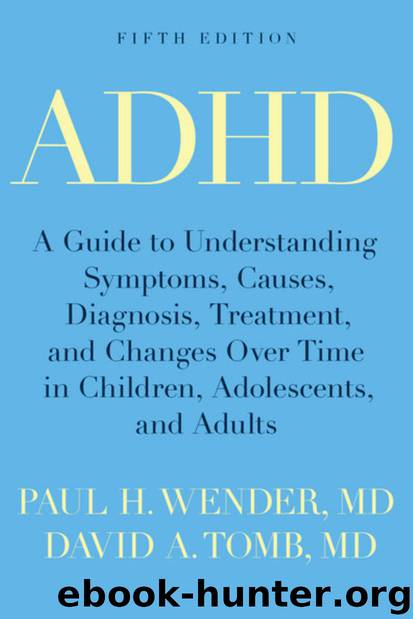
Author:Paul H. Wender & David A. Tomb
Language: rus
Format: mobi
ISBN: 9780190240264
Publisher: Oup Us
Published: 2016-10-03T21:00:00+00:00
159
✦
6
ATTENTION- DEFICIT
HYPERACTIVITY DISORDER
IN ADULTS
THIS CHAPTER IS BUILT AROUND a long- standing
research effort developed in the Department of Psychiatry
at the University of Utah School of Medicine. The research
was initiated in the mid- 1970s by Paul H. Wender, MD, and
included as key contributors Drs. Fredrick Reimherr and
David Wood. With the publication of our first scientific
study in 1976 about the use of medication in adult ADHD,
we became one of the first centers to recognize that ADHD
continued into adulthood and to begin to study such indi-
viduals. We undertook controlled experiments on the effects
of various drug treatments on approximately 200 patients
whom we diagnosed as ADHD children “grown up”— that
is, adults with continuing problems with ADHD. In addi-
tion, we conducted experiments on metabolism and drug
responsivity in a large number of patients with ADHD in an
effort to understand the underlying chemical abnormalities,
and we treated scores of patients clinically. Our experience is
therefore based on the treatment of several hundred ADHD
160
160 | ADHD
adults. (It has been a tremendous scientific advantage to
be able to work with adults. They can provide information
about the inner experience of being ADHD— something
children cannot do— and we have been able to learn about
the feelings, reactions, and lives of ADHD adults in a way we
never could from our studies of children. We can ask them
to give informed consent to allow us to conduct nonthera-
peutic experiments— something one cannot do with chil-
dren who cannot give truly informed consent.) Reports on
our work have been judged by editorial boards consisting
of experts in the field, were published in scientific journals,
and most all clinicians now agree that ADHD may indeed
persist in adults in their thirties, forties, and fifties, and that
in many instances adults with ADHD respond to stimulant
medication in a way similar to children with ADHD. Many
other investigators have become interested in this area.
At the time we began, most child psychiatrists believed
that ADHD diminished in adolescence and disappeared in
adulthood. Since then other investigators have explored the
development of ADHD children into adolescence and adult-
hood. As we discussed in Chapter 4, probably one- third to
two- thirds of ADHD children continue to have problems in
adult life, and as many as one- half of them continue to have
ADHD symptoms marked enough to interfere with their
functioning as students, workers, partners, or parents.
As we have said, a view that was held in the past was that
the reaction of ADHD children to stimulant medication was
“paradoxical.” Whereas stimulants usually produce eupho-
ria or excitement in adults, they seemed to result in quietness
and settling down in ADHD children. It is not clear whether
this same effect is produced in normal children because no
one has given stimulant drugs to non- ADHD children over
161
A DH D I N A DU LTS | 161
a period of weeks or months. However, when non- ADHD
children with learning disorders are given stimulant drugs,
such as Ritalin, they do not calm down but instead often
become anxious, irritable, and driven. Thirty years ago the
common belief was that, as ADHD children outgrew the
problems during adolescence, their paradoxical response
went away, and then, as older adolescents and adults, they
responded to stimulant medication in the normal way by
becoming excited, stimulated, and euphoric.
Download
This site does not store any files on its server. We only index and link to content provided by other sites. Please contact the content providers to delete copyright contents if any and email us, we'll remove relevant links or contents immediately.
Rewire Your Anxious Brain by Catherine M. Pittman(18711)
Talking to Strangers by Malcolm Gladwell(13441)
The Art of Thinking Clearly by Rolf Dobelli(10598)
Mindhunter: Inside the FBI's Elite Serial Crime Unit by John E. Douglas & Mark Olshaker(9421)
Becoming Supernatural by Dr. Joe Dispenza(8278)
Change Your Questions, Change Your Life by Marilee Adams(7847)
Nudge - Improving Decisions about Health, Wealth, and Happiness by Thaler Sunstein(7758)
The Road Less Traveled by M. Scott Peck(7662)
The Lost Art of Listening by Michael P. Nichols(7549)
Mastermind: How to Think Like Sherlock Holmes by Maria Konnikova(7432)
Enlightenment Now: The Case for Reason, Science, Humanism, and Progress by Steven Pinker(7355)
Win Bigly by Scott Adams(7266)
The Way of Zen by Alan W. Watts(6672)
Daring Greatly by Brene Brown(6557)
Big Magic: Creative Living Beyond Fear by Elizabeth Gilbert(5833)
Grit by Angela Duckworth(5673)
Ego Is the Enemy by Ryan Holiday(5527)
The Laws of Human Nature by Robert Greene(5325)
Men In Love by Nancy Friday(5292)
